L1 vs L2 vs L3: Which Wave Should You Ride?
Layer 1s, Layer 2s and Layer 3s explained in plain English, with a side-by-side comparison to help you pick the right layer for your project.
 By admin
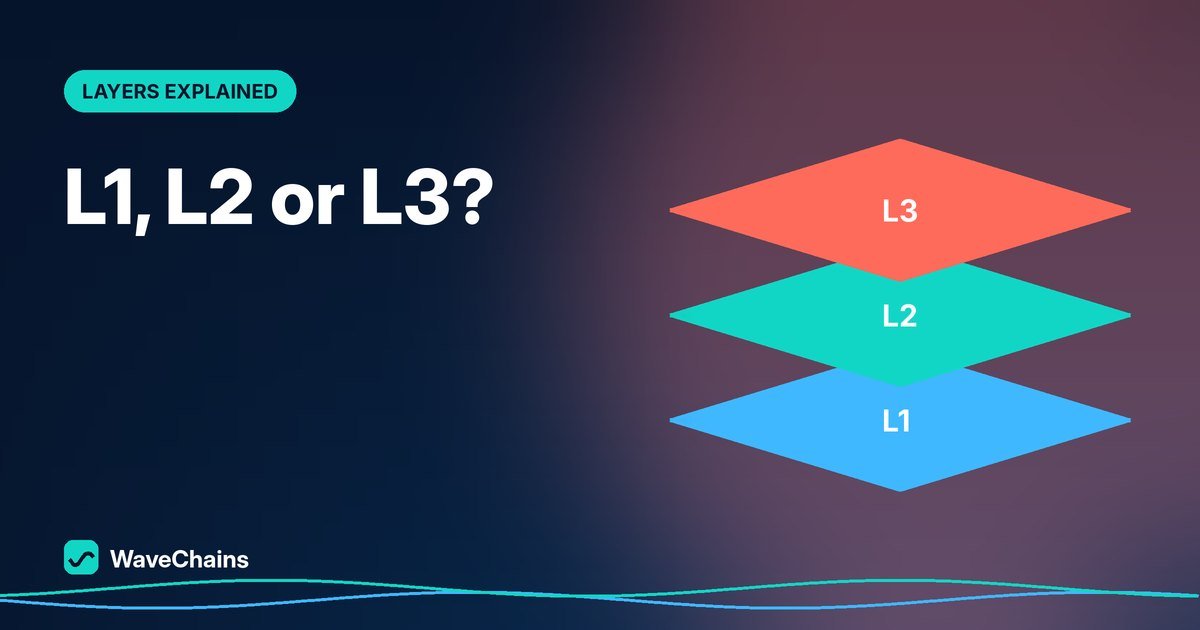
Spend five minutes in crypto conversations and you will hear people talk about L1s, L2s and, increasingly, L3s as if everyone was born knowing what they mean. They were not. The good news is that the core idea is simple, and once it clicks, a lot of blockchain architecture starts to make sense.
Think of it like the ocean. The deep water is the foundation: stable, slow to change, and hard to disturb. Waves form on top of it, moving faster and carrying more activity. And on top of the waves, surfers carve out their own specific lines. Each layer depends on the one below it, but each has its own job.
Layer 1: the deep water
A Layer 1 is a blockchain that is responsible for its own security and consensus. It has its own validators (or miners), its own rules for deciding which blocks are valid, and it does not rely on another chain to tell it what the truth is. Bitcoin, Ethereum, Solana, Avalanche’s primary network and Cosmos Hub are all examples.
Layer 1s tend to prioritize security and decentralization. That often means blockspace is limited and, during busy periods, transaction fees go up. Some L1s are designed for very high throughput, while others deliberately keep hardware requirements low so more people can run nodes. Either way, an L1 is the ground truth that everything above it ultimately points back to.
When you launch a sovereign L1 of your own, for example with the Cosmos SDK, you are responsible for recruiting validators and giving them a reason to secure the network, usually through staking rewards in a native token.
Layer 2: the waves
A Layer 2 is a separate chain that executes transactions off the L1 but anchors itself back to it. The most common type today is the rollup. A rollup bundles up many transactions, executes them, and posts the transaction data plus a commitment to the resulting state back to the L1.
Because the data lives on (or is verifiable through) the L1, anyone can reconstruct the L2’s state and, depending on the design, challenge or verify it. That is how an L2 “inherits” security from the layer below. There are two main flavors:
- Optimistic rollups, such as Arbitrum One, OP Mainnet and Base, assume batches are valid unless someone submits a fraud proof during a challenge window.
- ZK rollups, such as ZKsync Era, Scroll, Linea and Starknet, post validity proofs that mathematically show the new state is correct.
L2s give you much cheaper and faster transactions than Ethereum mainnet, while keeping a strong connection to Ethereum’s security and liquidity. That combination is why so many new chains in recent years have launched as L2s.
Layer 3: the surfers
A Layer 3 is a chain that settles to an L2 instead of directly to an L1. If an L2 is a rollup on Ethereum, an L3 is often a rollup on that rollup. Arbitrum Orbit chains that settle to Arbitrum One and some app-specific chains built on Base or other L2s are common examples of the pattern.
Why add another layer? A few reasons:
- Even cheaper settlement: posting to an L2 costs less than posting directly to Ethereum.
- Specialization: an L3 can be tuned for one app, like a game, a social network or a trading venue.
- Ecosystem alignment: settling to a specific L2 can put you close to that L2’s users, liquidity and tooling.
The trade-off is that each layer adds dependencies. An L3 inherits the assumptions of its L2, which in turn inherits from the L1. Withdrawals all the way to Ethereum may take longer, and bridging between layers adds complexity for users.
Side-by-side comparison
| Factor | Layer 1 | Layer 2 | Layer 3 |
|---|---|---|---|
| Security source | Its own validators and consensus | Inherits largely from the L1 it settles to | Inherits from its L2 (and indirectly the L1) |
| Typical transaction cost | Varies widely; can be high when busy | Low | Very low |
| Customization | Total, if you build your own | High (gas token, fees, precompiles, permissions) | Very high, often app-specific |
| Bootstrapping effort | High: recruit validators, design staking | Moderate: frameworks and RaaS help a lot | Moderate, similar to an L2 |
| Access to liquidity | Must build your own | Close to the L1’s liquidity and users | Close to the parent L2’s ecosystem |
| Best for | Sovereign ecosystems, new base layers | General-purpose chains, DeFi, brands | Games, single apps, niche communities |
Where does data availability fit in?
There is one more term you will hear a lot: data availability (DA). A rollup needs to publish its transaction data somewhere so anyone can check its work. Posting to Ethereum (using blobs introduced in the Dencun upgrade) is the most secure option for Ethereum rollups. Alternative DA layers like Celestia, EigenDA and Avail can be cheaper, but they change the security assumptions. Chains that post data somewhere other than their settlement layer are sometimes called validiums or optimiums rather than pure rollups. We cover this in detail in our data availability guide.
How to choose your layer
Choose an L1 if…
- You need full sovereignty over consensus, governance and upgrades.
- You have, or can build, a community willing to run and stake on validators.
- Your design genuinely needs a custom consensus or execution model.
Choose an L2 if…
- You want strong security guarantees tied to Ethereum without running a validator set.
- You are building a general-purpose ecosystem, a DeFi hub or a brand chain.
- Easy access to Ethereum liquidity and wallets matters to your users.
Choose an L3 if…
- You are building one high-volume application, like a game, and need very low fees.
- You want to be close to a specific L2’s community and tools.
- Your users rarely need to move assets all the way back to Ethereum.
The layers are blurring, and that is fine
In 2026, the lines between layers are less rigid than the labels suggest. Shared sequencing, interoperability networks, aggregation layers and fast bridges are making it easier to move between chains without users needing to know which layer they are on. The best user experiences hide the layers entirely. Your job as a builder is to pick the architecture that fits your security, cost and control needs, then make the complexity invisible.
Want to go deeper? Browse the Learning Center, see which ecosystems lead in Top Chains, or let WaveChains help you launch on the right layer.
Keep riding
Data Availability Explained: Ethereum Blobs, Celestia, EigenDA and Avail
Why data availability matters for rollups, and how Ethereum blobs, Celestia, EigenDA and Avail compare on security, cost and trade-offs.
OP Stack vs Arbitrum Orbit vs ZK Stack vs Polygon CDK: Choosing a Rollup Framework
A practical, side-by-side look at the four major rollup frameworks and how to choose the one that fits your chain, team and ecosystem.